Product Growth Strategy for a Student Housing Marketplace
Role
Growth Product Management Intern
Timeline
Jun 2025 - Oct 2025
(10 weeks)
Tools
Google Sheets, Figma, basic analytics tracking, email and social pilots
Status
Delivered and used in next-step plans.
Overview
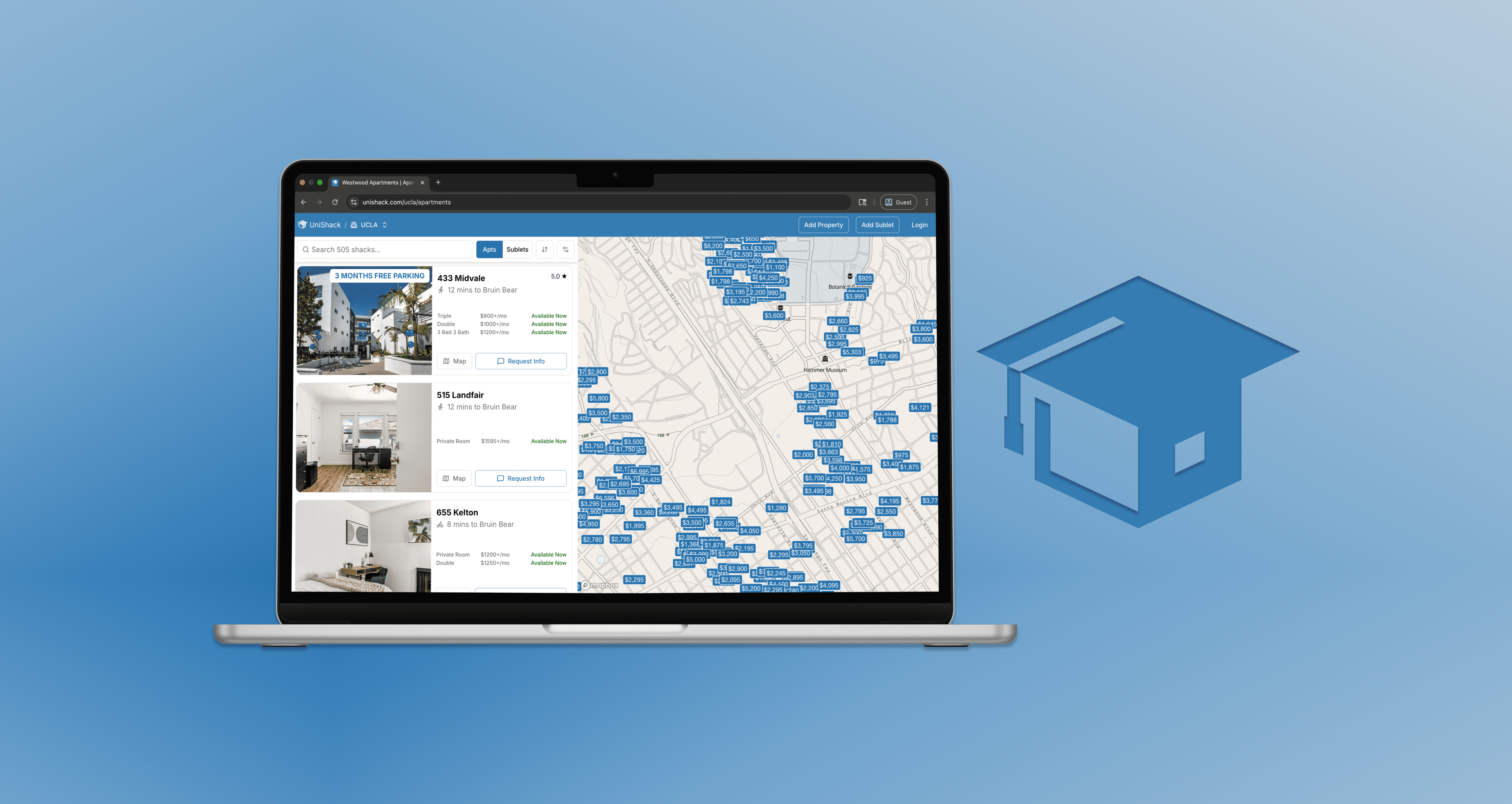
UniShack helps college students find safer housing near campus by prioritizing verified listings and trust signals. I turned competitor research and user outreach into a clear “how we win” strategy and a prioritized product and growth roadmap. I built a trust-led plan for students and property managers to increase verified listings and drive more student-to-landlord contact so students can find housing faster and avoid scams.
Problem
UniShack is a two-sided marketplace. Students need trustworthy housing options. Property managers need qualified student leads. The core risk is scams and low trust, so growth depends on verified supply and clear trust signals. Competitors can win on traffic, but traffic does not equal trust. Students hesitate to act because they do not trust listing quality, and property managers do not finish listings because the value is not clear. This reduces verified supply and slows lead volume.
Deliverables
Competitive analysis deck with positioning, matrix, SWOT, market data, and “how we win” strategy
Competitor scoring system across trust, search, user tools, marketing, pricing model, and support
Outreach interviews (students + property managers) + synthesized user stories
0–180 day roadmap (trust → stickiness → demand) with KPIs
Messaging pilots (email + Instagram) + results summary
+15%
verified listings
340+
user insights collected
15
user stories created
Target users
Primary user: Student (renter)
Job: Find safe housing near campus fast
Pain: Scam fear, low confidence in listings
Success: Contact a verified listing and move forward without leaving the platform
Secondary user: Property manager (supplier)
Job: Publish a listing and get qualified student leads
Pain: Unclear ROI, friction to complete listing and verification
Success: Publish quickly, get leads, and see proof of value
Success metrics
North star
Verified leads (student-to-manager contact) per week
Input metrics
Verified listings added
Signup-to-contact rate (student)
Listing completion rate (property manager)
Referral conversion (manager invites)
Guardrails
Support requests per 100 users (trust and safety signal)
Post-interaction satisfaction rating
Insights
What I learned
Big platforms win on traffic, but they do not win on student trust or student-first workflows
Social platforms pull attention, but they stay unsafe and unverified
UniShack’s edge is “free + verified + campus-first,” but it needs stronger trust cues and local growth loops
Root cause
UniShack cannot out-rank the big marketplaces today, so pure SEO and paid acquisition won’t work. The fastest path is to out-trust them by making verification obvious, building local campus credibility, and adding features that keep students coming back.
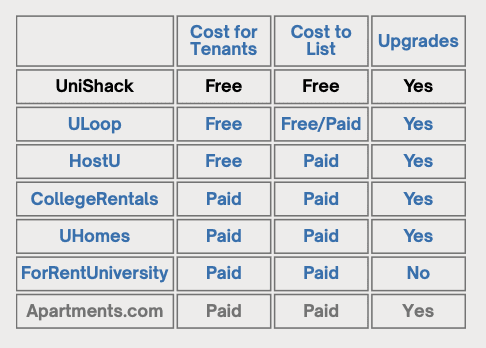
competitor pricing model
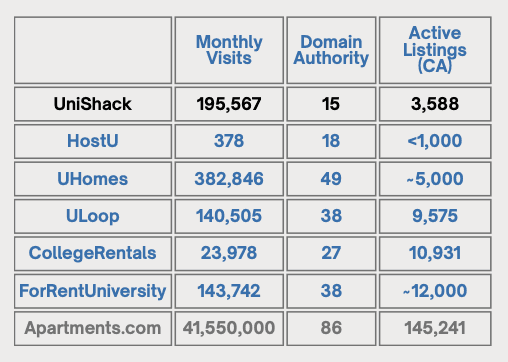
competitor seo gap
Approach
Goal: Increase verified supply and verified leads by building trust first, then scaling distribution.
Product principles
Make trust visible on every listing
Build campus-by-campus, not nationwide
Use community trust loops before paid growth
Add stickiness so users return while supply grows
Prove value fast for both sides
Hypotheses
If we launch ambassadors and “How we verify,” then verified listings rise because students and landlords see proof and peer trust.
If we add saved search alerts and reviews, then return rate rises because we create repeat reasons to come back.
If we add roommate matching, then we widen the job-to-be-done and increase retention.
Prioritizing
Option 1: Compete on broad SEO
Pros: Scales over time
Cons: Big sites dominate today; slow feedback loop
Decision: Rejected
Option 2: Paid ads to buy demand
Pros: Fast top-of-funnel
Cons: High cost, low trust conversion, weak supply quality
Decision: Rejected
Option 3: Campus trust loops (ambassadors + verification + reviews)
Pros: Uses UniShack strengths; creates local credibility; lower cost
Cons: Operational effort; needs clear targets and accountability
Decision: Chosen
Final decision
I centered the strategy on “we cannot out-rank today, so we out-trust,” then built a 0–180 day plan that starts with trust, adds stickiness, and scales demand once the marketplace has quality supply.
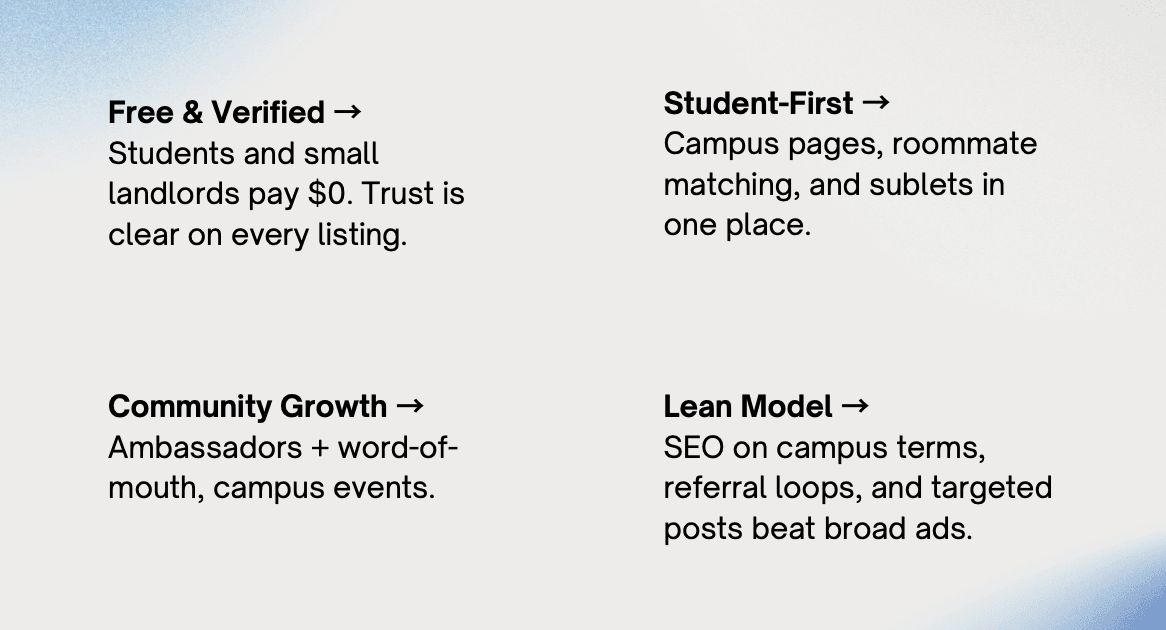
"how we will win" strategy
Scope and roadmap
MVP scope (0–30 days: gain trust)
Launch campus ambassador program with targets per ambassador
Publish “How we verify” page and add verified badges
Start property manager referral program to grow supply
Add reviews flow to strengthen trust
Out of scope (for the first phase)
Nationwide expansion
Heavy paid acquisition
Full mobile app build (flagged as a weakness, but not the first move)
Milestones
Discovery: competitor testing, review mining, funnel mapping
Spec and alignment: scoring system, SWOT, positioning, “how we win”
Pilots: IG/email messaging tests
Roadmap: 0–30, 30–90, 90–180 execution plan
Execution
I built a five-competitor analysis and scored each platform across key marketplace factors.
Listings/Search, User Tools, Marketing/Outreach, Pricing model, Support/Safety
I compared UniShack to direct, benchmark, and indirect competitors.
The matrix showed the tradeoff clearly: Big sites = scale, not trust. Niche sites = student focused, but lack reach. Social = popular, but unsafe. UniShack = free, student-first, verified.
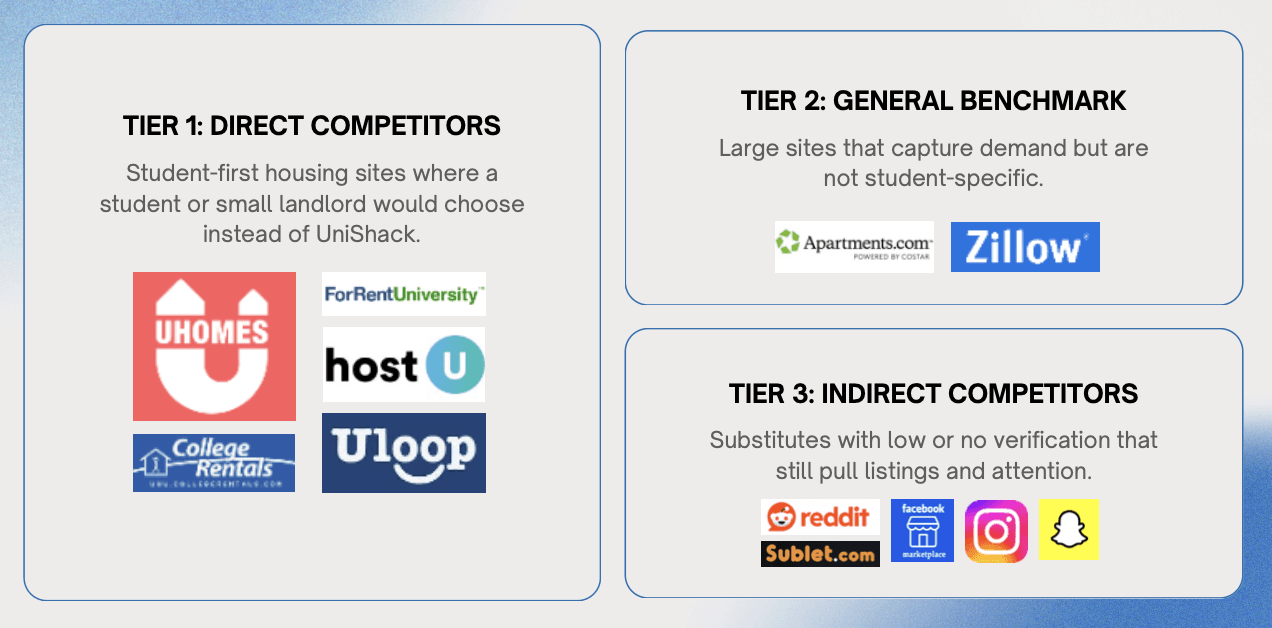
direct, indirect, and general competitors
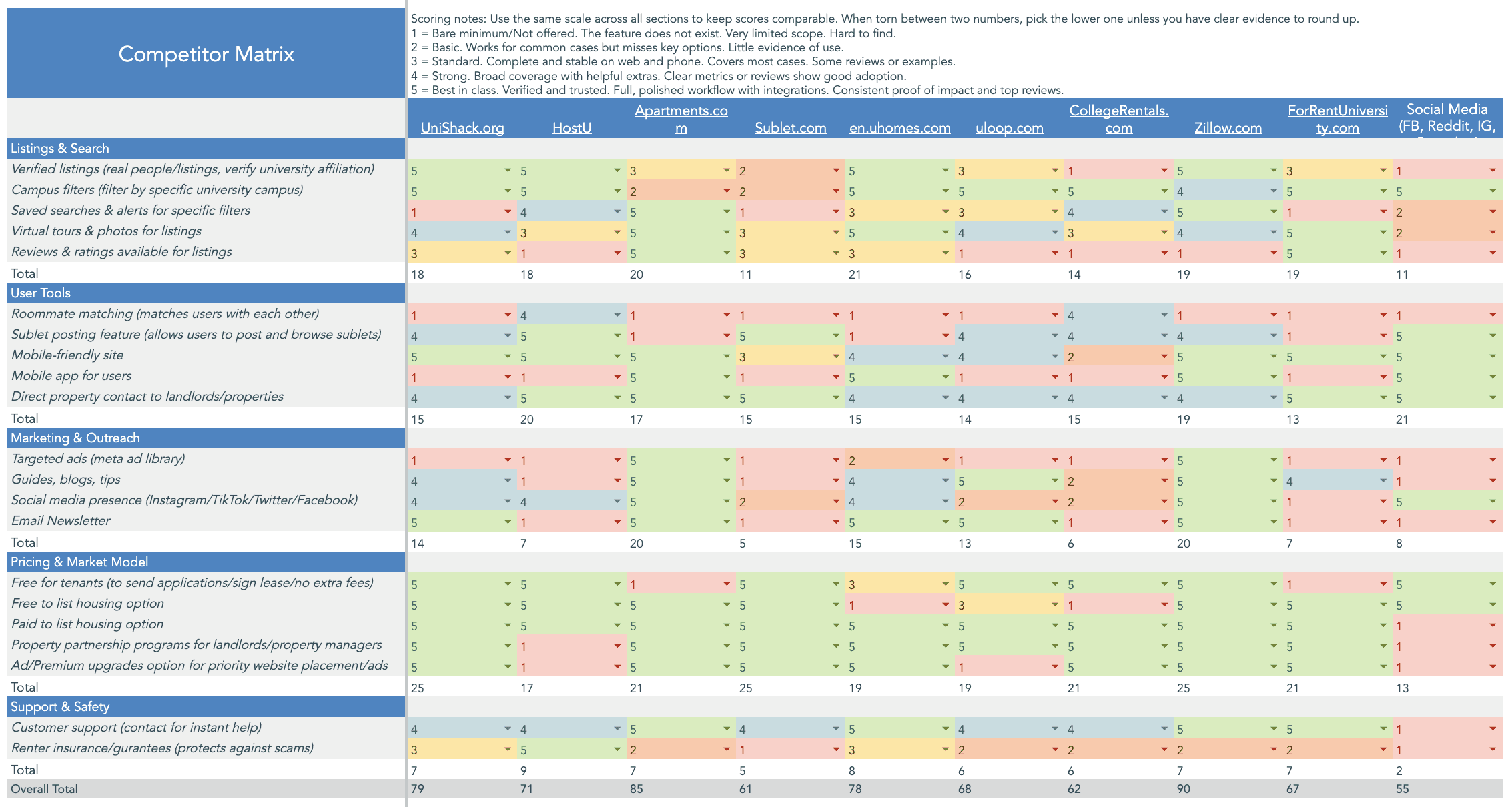
competitor matrix table
I kept the work aligned by turning qualitative outreach into concrete user stories tied to MVP choices.
I contacted 300+ students and 40+ property managers to learn where onboarding and listing setup failed.
I wrote 15 user stories to turn outreach into build-ready needs.
I helped plan and run IG/email pilots that tested trust-first copy angles (example: speed vs scam avoidance).
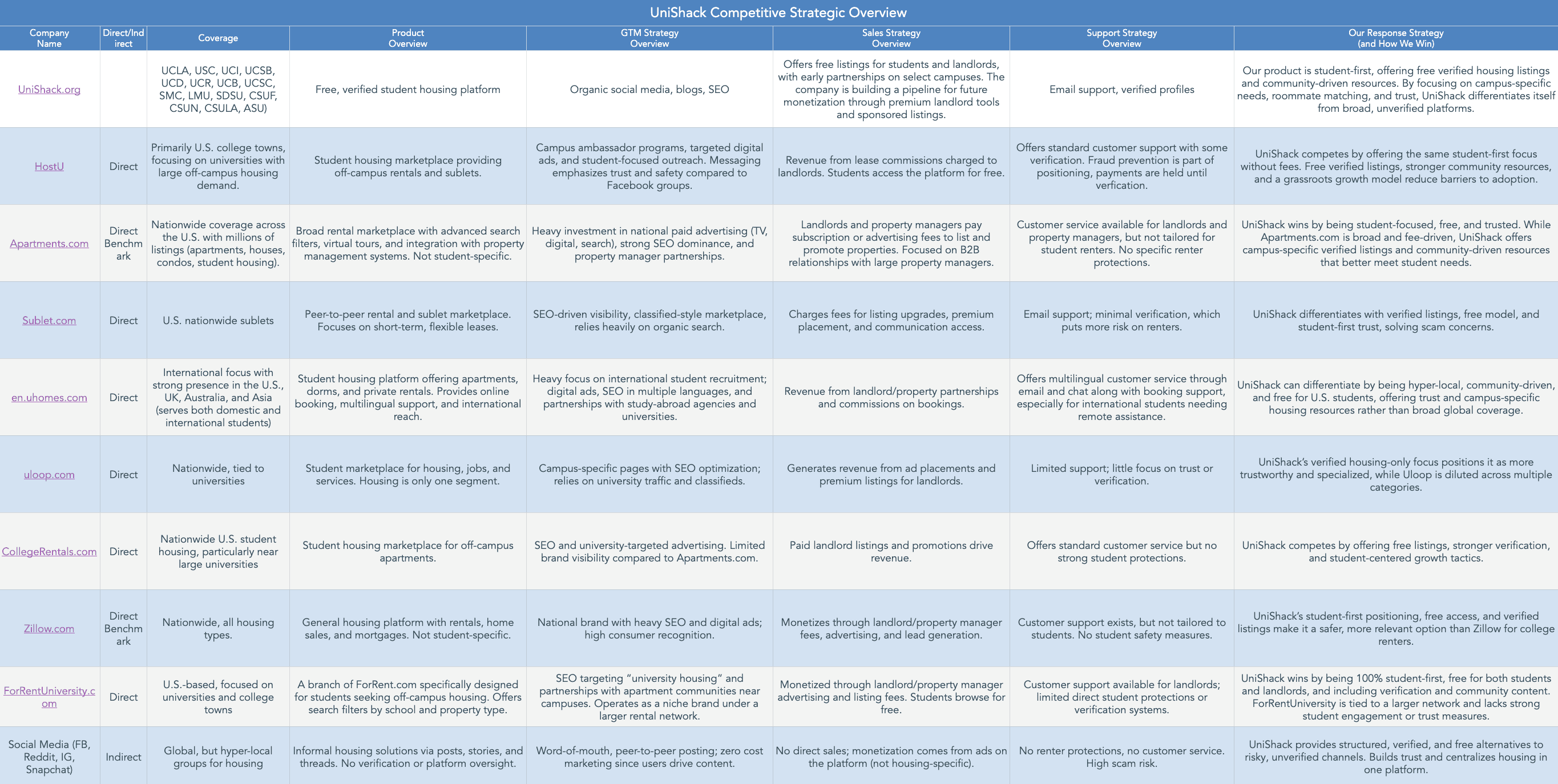
competitive strategic overview
Launch plan
Spec highlights (what I handed off)
Competitor matrix and positioning map (general → student-specific, unverified → verified)
“How we win” pillars: free + verified, student-first, community growth, lean model
KPI ladder: awareness → engagement → supply → trust → retention
Next-step backlog with concrete feature bets (alerts, reviews, roommate matching, landlord intake)
Rollout
0–30 days: ambassadors, verification page, trust badges, reviews, and early alerts
30–90 days: roommate matching, campus guides, saved-search alerts via email/SMS
90–180 days: one-page landlord intake with incentives, referral loops, light monetization tests
Comms
Weekly share-outs to align on targets, learnings, and next experiment queue
Risk plan
Track trust signals and support load as growth increases
Keep verification standards high to avoid supply growth that harms trust

competitor matrix table
Results
I strengthened UniShack’s strategy with a structured view of the market, clear positioning, and a roadmap that matched the team’s size and constraints. My outreach work helped identify why users dropped off and turned raw feedback into 15 user stories that supported MVP planning. Early messaging tests contributed to improved supply and conversion signals, including a reported lift in verified listings. Most importantly, the work gave the team a shared language for what to measure next: awareness → engagement → supply → trust → retention.
Observed in pilots
Verified listings increased 15% during the test window.
Signup-to-contact rate: 8.0% → 10.4% in 4 weeks (+2.4 pp, +30%).
Strategy output
Delivered a competitive analysis with 4 market gaps and 9 actions designed to raise verified leads by 20%.
Created a reusable competitor framework the team used for near-term decisions.
Reflection
I learned to balance depth with speed. In a startup, a strong draft now often beats a perfect answer later. Fast drafts are rewarded with fast feedback. I had to stop over-researching and iterate sooner. Next time, I would start benchmarking earlier and standardize the metric tracking plan before running campaigns.