Product-Led Growth Plan for a Campus Social App
Role
Product Consultant (Contract)
Timeline
Apr 2025 - May 2025
(8 weeks)
Team
Google Docs, Slides, Sheets (plan, flowcharts, budget model, KPI tracking).
Status
Strategy delivered
Overview
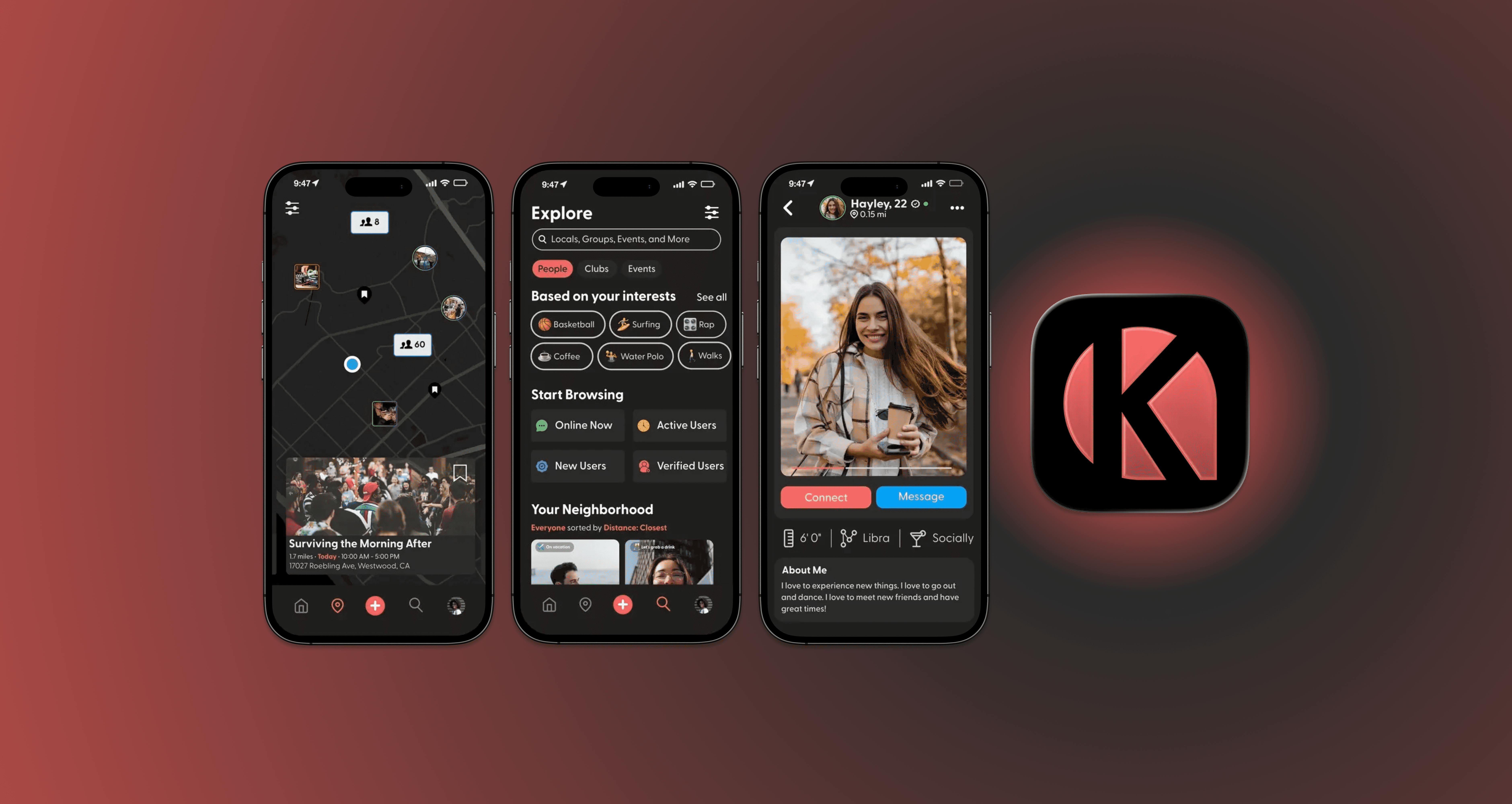
Kardder is a location-based social networking app that helps people connect with others nearby and discover local events. It uses proximity features like Bluetooth device recognition, a local event timeline, a map of events, and a “down-to-meet” toggle that helps users signal intent and boundaries. The business goal was to grow adoption on a college campus, starting with UCLA. I built a UCLA go-to-market plan for undergrads to meet people nearby and find events, so Kardder could grow installs and active use on campus.
Problem
Students had many options for social apps, and Kardder lacked steady social proof and consistent top-of-funnel visibility, which limited installs and on-campus adoption. Kardder had an early UCLA user base, but the product story did not land fast enough for students. Competitor pages communicated their “why” more clearly than Kardder’s did, and that gap showed up in downloads and social followings. Separately, the team wanted to avoid the “this is a dating app” misconception and instead lead with real-time social connection and missed connections. So the core problem became: increase awareness and installs at UCLA by tightening positioning and building a simple growth plan the team could run and measure.
Deliverables
Launch strategy (UCLA-specific)
Target market + personas
Positioning statement and messaging frame
Channel tactics + flowcharts
Budget breakdown (event + creator spend)
Measurement plan (installs, accounts created, awareness survey)
+50%
awareness goal
+10,000
acquisiton goal
+7,500
followers goal
Target users
Primary user: UCLA undergrad
Job: Find people nearby and decide what events to go to.
Pain: New setting, limited connections, and friction finding social plans.
Success: Installs, account creation, and meaningful first-use (discover an event or start a connection).
We targeted full-time UCLA undergrads who want friends and events, with extra focus on first-years and transfer students who have fewer built-in connections.
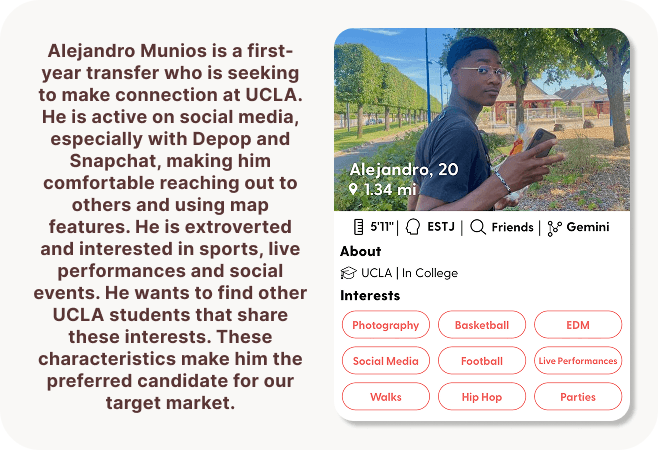
Persona A
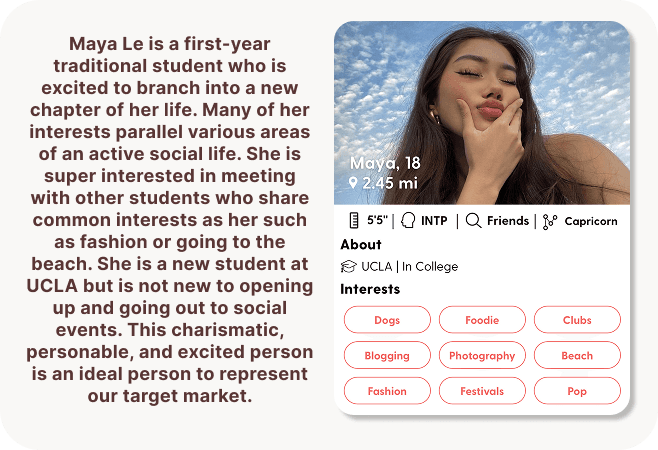
Persona B
Success metrics
North star
New user acquisition on campus: app downloads and new accounts created.
Input metrics
Instagram follower growth (brand awareness)
Survey lift in awareness (pre vs post)
Event-driven installs per activation (booth, collabs, creators)
Guardrails
Privacy trust and “not a dating app” clarity in messaging, since privacy concerns are a known risk in this category.
Insights
What I learned
Kardder’s edge is real-time, proximity-based connection. Emphasize “nearby means nearby” (GPS/Wi-Fi/Bluetooth proximity).
The market is crowded, so campus activation needs strong incentives and visible social proof.
Kardder shared product activity signals like sessions (94,922) and chat messages (122,581). So the main risk was not “do users ever engage,” but “can we get more of the right UCLA students to try it.”
Kardder’s Instagram has a follower count of 3,545 and a low engagement rate of 0.40%. Apps that highlight their main value in one line tend to win on followers and downloads.
Root cause
Growth would stall if people did not quickly understand what Kardder is for and why it fits campus life. The plan fixed this by pairing clear positioning with repeated, in-person triggers to install and try the app at the exact moment students want to meet people and find plans. Additionally, if Kardder can grow its Instagram followers, it’s likely to gain a large number of monthly downloads.
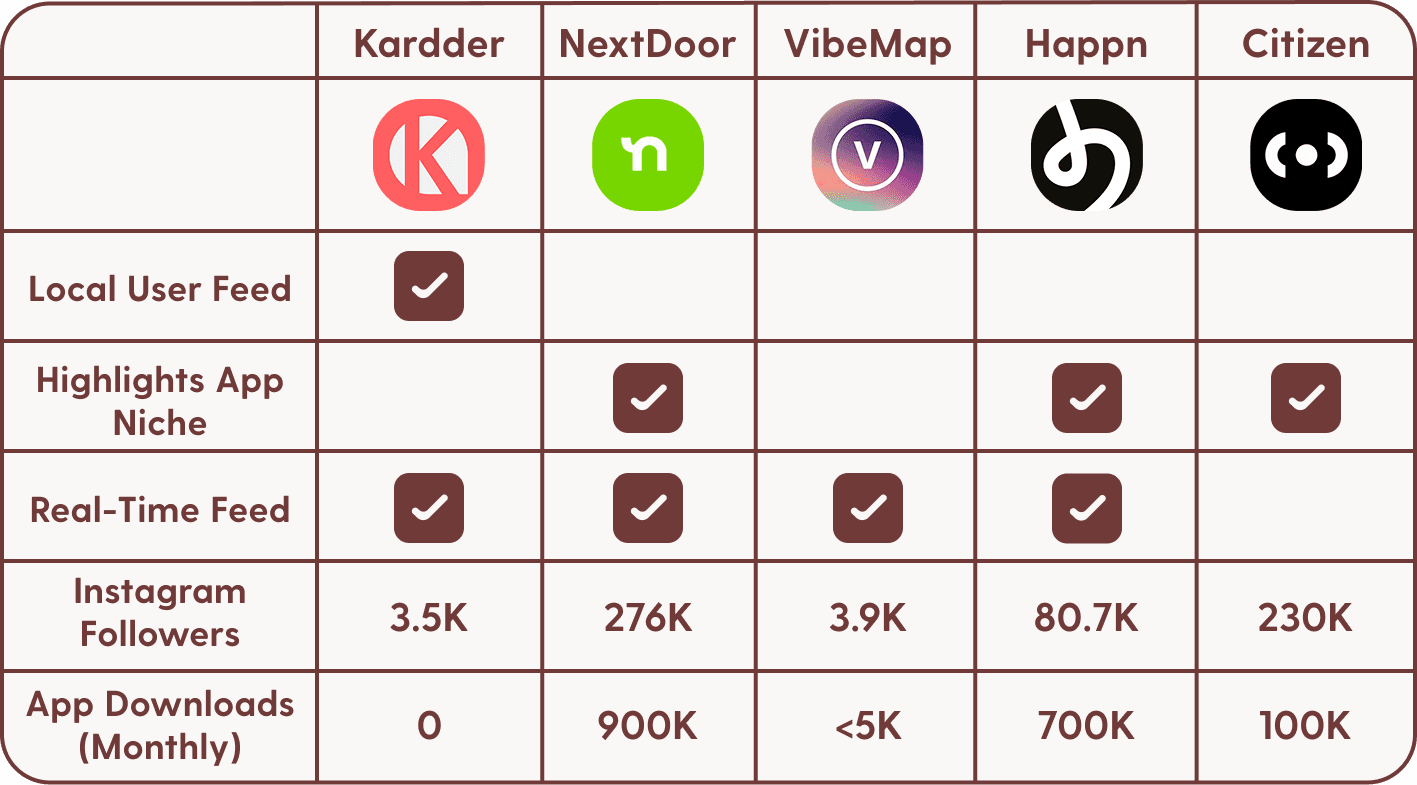
Competitor analysis chart
Approach
Goal
Increase UCLA adoption by pairing event-based activation with consistent social proof.
Product principles
Make the “real life proximity” value obvious in the first 5 seconds.
Use events as the hook, not ads.
Build trust fast with clear boundaries and privacy framing.
Hypothesis
If we drive installs through high-traffic campus moments and tie them to incentives, then installs and new accounts will rise because students already show “meet people” intent during those moments.
Positioning statement
Prioritizing
Option 1: Paid digital ads only
Pros: Fast spend, easy targeting
Cons: Low trust, easy to ignore on campus
Option 2: Pure influencer push
Pros: Social proof
Cons: Weak conversion without a real-world trigger
Option 3: Campus activations + org partnerships (chosen)
Pros: High intent, fast installs, repeatable playbook
Cons: Ops-heavy and needs staffing
Decision
I chose campus activations plus partnerships because the plan goal was campus adoption, and the product’s advantage is proximity in the physical world. I prioritized tactics that forced a clean “value exchange”: install + follow in return for access, prizes, or a fun moment. That matched our goals of awareness, acquisition, and social growth.
Scope and roadmap
MVP scope
On-campus booth activation with QR installs and prizes
Partnerships with student orgs and Greek life to require installs for entry
Creator content to reinforce “what it is” and drive social proof
Out of scope (for the first push)
Multi-campus expansion before UCLA repeatability proved out
Milestones
Discovery: baseline metrics + message testing
Build: tracking plan + event ops checklist
Launch: campus activations + partnerships
Measure: installs, accounts created, awareness survey
Execution
Wrote the plan as a single source of truth (strategy, tactics, flowcharts). Turned goals into a measurement plan (what to track and how).
Tactics I shipped into the roadmap:
Meet the Hill booth (week 0) as the “top of funnel” push
Event partnerships (fraternities, CAC concert series, UCLA Health pop-ups) to borrow existing demand
Competitive events to create repeatable installs and content (basketball, tug-of-war, dodgeball)
Instagram giveaways to drive follows, tagging, and story reposts
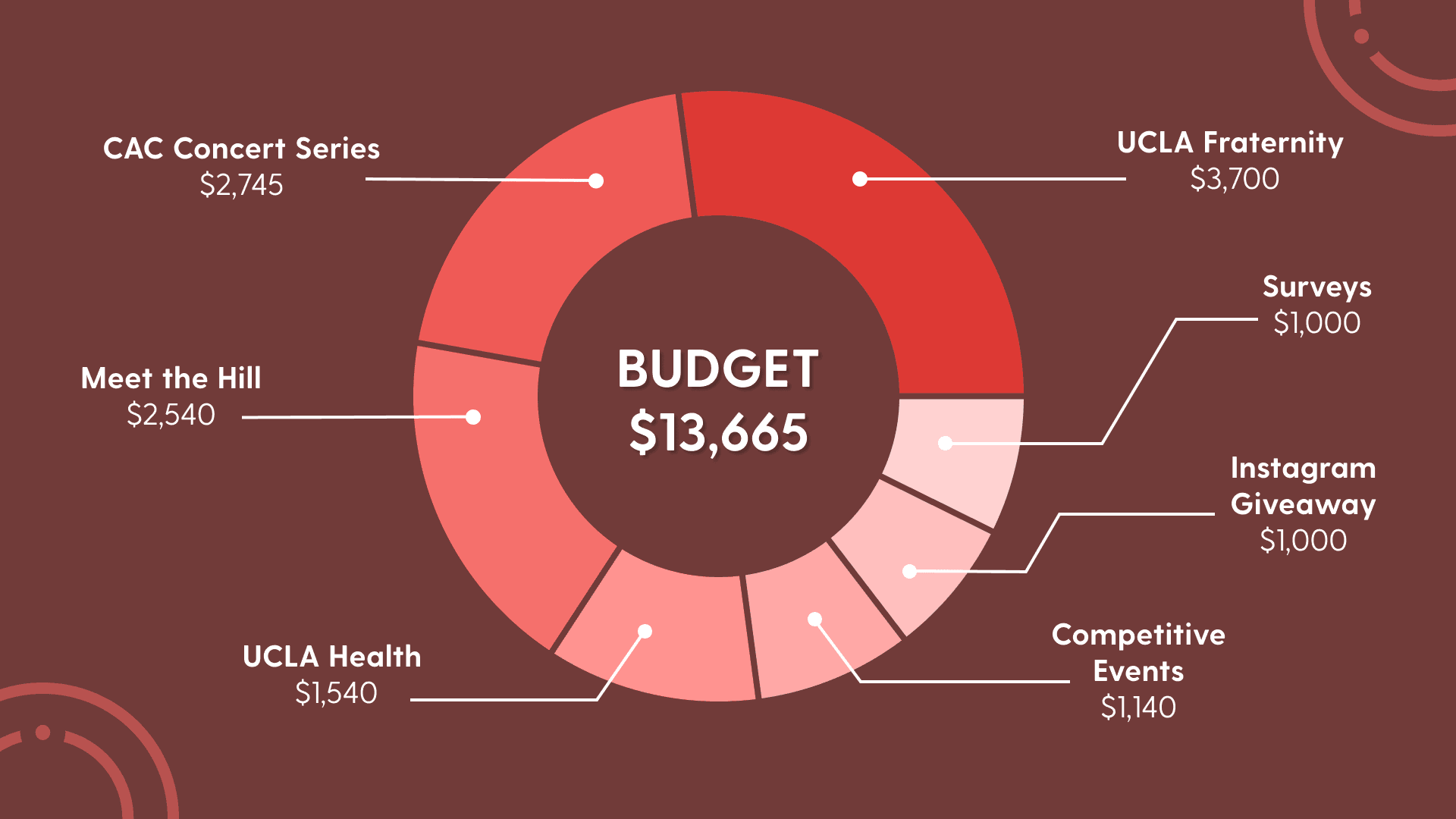
Built a budget that matched the monthly spend constraint:
The plan budget totaled $13,665, with clear per-event breakdowns (ex: Meet the Hill $2,540; CAC concert $2,745; fraternity collab $3,700). Kardder also shared a target campaign budget range of $3,000–$5,000 per month, so the plan fits a multi-month push.
Budget breakdown
Launch plan
Rollout
Launch at a high-traffic UCLA moment with a booth and prize wheel to drive installs.
Stack partnerships (org events + Greek life) to create repeated install triggers.
Enablement
Simple scripts for booth staff and partners (how to pitch in one sentence).
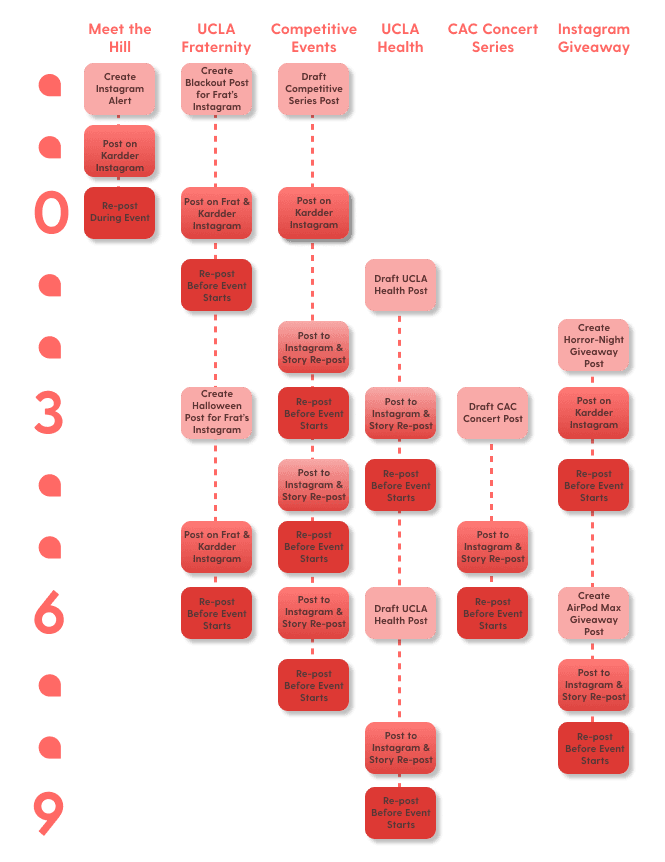
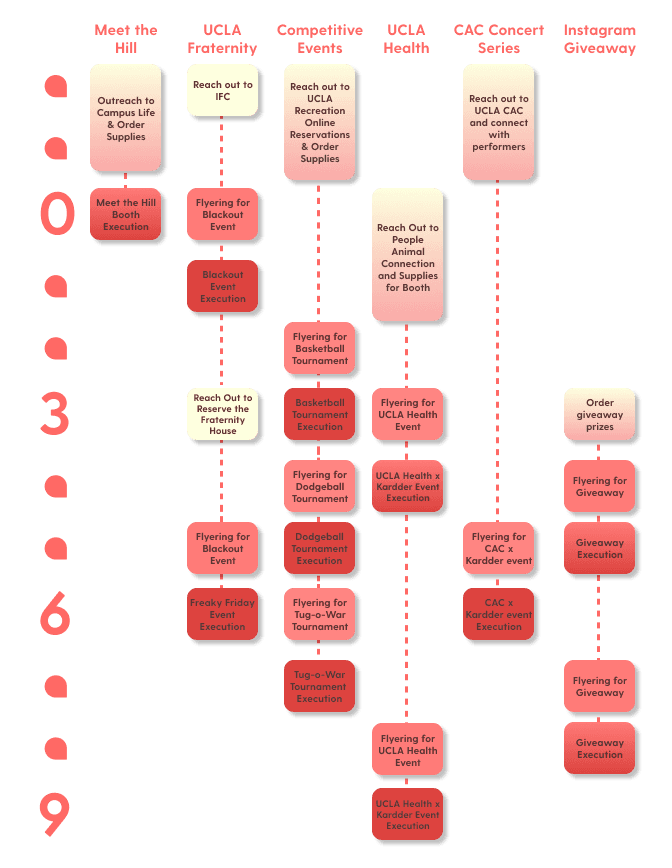
I also created two operating tools so execution stayed consistent:
An event flowchart that mapped dependencies (outreach, reserving, supplies, flyering)
A media flowchart that mapped what to draft, post, and repost around each event
Risks + mitigation
Privacy concerns: lead with boundaries and clarity on how proximity works.
Media flowchart
Event flowchart
Results
This work delivered a measurable go-to-market blueprint rather than a shipped product feature. The impact was a complete measurement plan that tied each tactic to acquisition and awareness metrics.
For followers, the plan tracked Instagram followers before and after and targeted +7,500 followers over three months.
For acquisition, it tracked downloads and accounts created each day, then summed growth after three months with a target of +10,000.
For awareness, it used a pre and post survey to measure “have you heard of Kardder” and gather product feedback with a target of +50%.
Baseline product activity also helped frame the opportunity (example engagement signals shared by Kardder: sessions, profile visits, nearby searches, and chat messages).
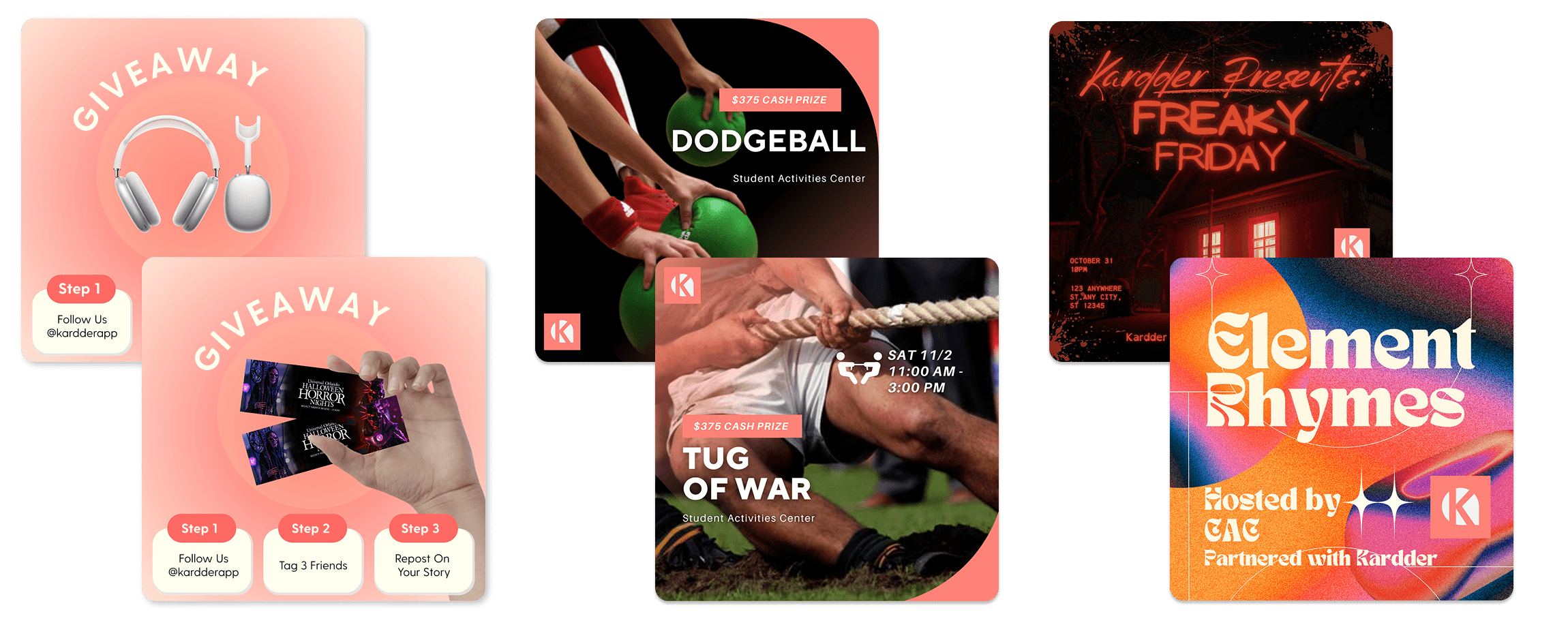
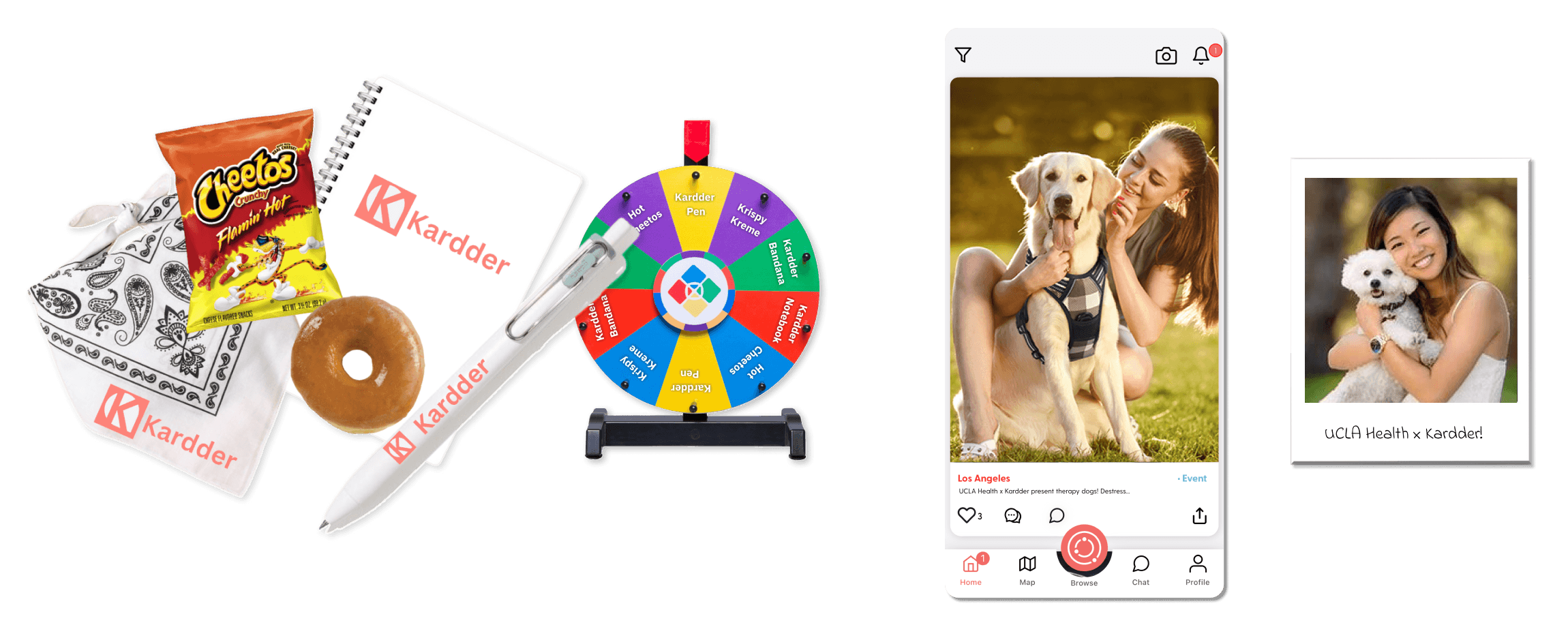
Sample media and events
Reflection
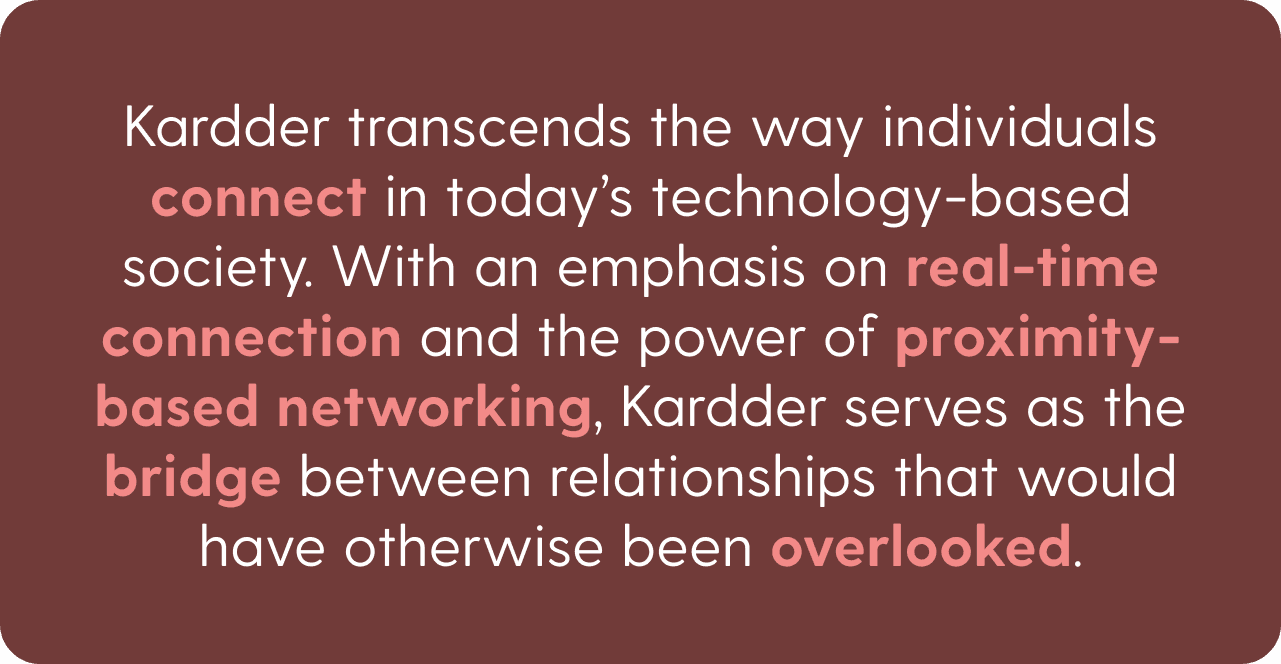
This project reinforced a simple PM rule: if users cannot explain the product in one sentence, growth stalls. That is why I anchored the plan on clear positioning: real-time social networking, truly nearby connections, and student co-creation.
If I ran the next iteration, I would add tighter funnel instrumentation per event (QR scans to installs, installs to account creation) and run message A/B tests for the “not a dating app” framing versus “missed connections” framing. That would let the team shift budget toward the highest-converting channel faster. I would also add lightweight retention loops tied to events (follow, RSVP, invite a friend) so installs turn into repeat use.